 Before talking about the male gaze, it is first important to introduce its parent concept: the gaze. According to Wikipedia the gaze is a concept used for “analysing visual culture… that deals with how an audience views the people presented.” The types of gaze are primarily categorized by who is doing the looking.
While the ideas behind the concept were present in earlier uses of the gaze, the introduction of the term “the male gaze” can be traced back to Laura Mulvey and her essay “Visual Pleasure and Narrative Cinema” which was published in 1975. In it, Mulvey states that in film women are typically the objects, rather than the possessors, of gaze because the control of the camera (and thus the gaze) comes from factors such as the as the assumption of heterosexual men as the default target audience for most film genres. While this was more true in the time it was written, when Hollywood protagonists were overwhelmingly male, the base concept of men as watchers and women as watched still applies today, despite the growing number of movies targeted toward women and that feature female protagonists.
Though it was introduced as part of film theory, the term can and is often applied to other kinds of media. It is often used in critiques of advertisements, television, and the fine arts. For instance, John Berger (1972) studied the European nude (both past and present) and found that the female model is often put on display directly to the spectator/painter or indirectly through a mirror, thus viewing herself as the painter views her.
For Berger these images record the inequality of gender relations and a sexualization of the female image that remains culturally central today. They reassure men of their sexual power and at the same moment deny any sexuality of women other than the male construction. They are evidence of gendered difference… because any effort to replace the woman in these images with a man violates ‘the assumptions of the likely viewer’ (Berger, 1972: 64). That is, it does not fit with expectations but transgresses them and so seems wrong.
[Wykes and Barrie Gunter (pp. 38-39)]
The male gaze in advertising is actually a fairly well-studied topic, and it — rather than film — is often what comes to mind when the term is invoked. This is because, more than just being an object of a gaze, the woman in the advertisement becomes what’s being bought and sold: “The message though was always the same: buy the product, get the girl; or buy the product to get to be like the girl so you can get your man” in other words, “‘Buy’ the image, ‘get’ the woman” (Wykes, p. 41). In this way, the male gaze enables women to be a commodity that helps the products to get sold (the “sex sells” adage that comes up whenever we talk about modern marketing). Even advertising aimed at women is not exempt: it engages in the mirror effect described above, wherein women are encouraged to view themselves as the photographer views the model, therefore buying the product in order to become more like the model advertising it.
If you look at the image at the top right of this post, you can see that the image being sold to men is that of an attractive woman (they are encouraged to look at her in the same way the men on the curb are) while the image being sold to women is that if they buy the product that they, too, can be the recipients of male attention. Thus the image being sold, for both men and women, quite literally becomes that of the male gaze.
As feminist popular culture critics emerge, so does the use of the term in regard to areas such as comic books and video games. Indeed, it is from one of those areas that we can find a clear example of the male gaze in action:
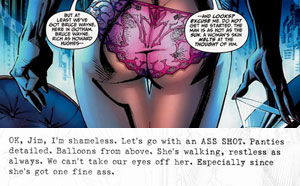
The above image, which is a panel taken from the comic All Star Batman And Robin, the Boy Wonder juxtaposed with the script written by author Frank Miller (released in the director’s edition of the comic), illustrates the way that the male gaze works in a concrete way. When Miller says, “We can’t take our eyes off her” he is speaking directly of his presumably male audience, and the follow up (“Especially since she’s got one fine ass.”) says loud and clear that her sexualized portrayal is for the pleasure of the envisioned heterosexual male viewer. In essence, Viki Vale’s character is there to reassure the readership of their hetero-masculinity while simultaneously denying Vicki any agency of her own outside of that framework. She is the quintessential watched by male watchers: the writer/director (Frank), his artist, and the presumed male audience that buys the book.
As illustrated in the above examples, the term has applications outside of the framework that Mulvey initially imagined. Although it is most easily illustrated in places where creator intent is clear (or, in Frank Miller’s case, blatantly stated), creator intent is not actually a prerequisite for a creation to fall under the male gaze. Nor does the creator and/or the audience have to be male, nor does the subject of the gaze have to be unhappy with the result. In the end, the simplest way to describe the male gaze is to return it to its roots of the female model/actress/character being looked at by the the male looker.
And, well, if you’re still confused you can go read this Dinosaur Comic about it. It gives an overview of the subject in 6 panels, placing it in the humorous context of talking dinosaurs! And everyone knows things always make better sense when they’re put into context by talking dinosaurs.
Related Reading:
Introductory:
- Laura Mulvey (1975). “Visual Pleasure and Narrative Cinema”. Screen 16 (3): 6-18.
- Nancy M. Brannon (Feminist Theory, Spring 99): The Patriarchal Gaze
- (TV Tropes Wiki): Male Gaze
- Ryan North (Dinosaur Comics): October 06 2006
- Maggie Wykes and Barrie Gunter (The Media and Body Image, 2005): “Ways of seeing women”, pp. 38-47.
- Daniel Chandler (Notes on ‘The Gaze’): Laura Mulvey on film spectatorship
- Examples of the male gaze: Scott A. Lukas (The Gender ADs Project): The Male Gaze
Clarifying Concepts:
- Gender differences in seeing women:
Men look at women. Women watch themselves being looked at. This determines not only most relations between men and women but also the relation of women to themselves.
[Berger, John. (1972): Ways of Seeing, p. 42]
- Layers of the male gaze:
This article effectively, although unintentionally, reveals the layers and layers of perception that surround us. Bailey Rae sees objectification in images where women are blatently sexualised and speaks out against it. However she is apparently not aware that she can still be objectified and sexualised despite keeping her midriff covered. I think a certain blindness to aspects of the patriarchy can affect us all, purely because we are all products of it in one way or another.
[la somnambule (la somnambule): Where does the male gaze end?]
- How the male gaze interacts with sexual objectification:
In Miller’s hands, photographer Vicki Vale becomes a gossip columnist “gadfly” who struts around her apartment in lacy lingerie and fluffy heels, sipping a martini, and dictating to herself while Gotham City gleams in the huge, uncurtained, picture windows behind her.
[…]
Frank wants you to drool over Vicki Vale. She’s hot! She knows what she’s got! She’s strutting around her own apartment – technically alone – but you, dear reader, you are allowed in to watch. She’s stripped down for *you*.[Karen Healey (Girls read comics): I HAVE A DATE WITH BRUCE WAYNE.]
- tekanji (Official Shrub.com Blog): Obscuring the Male Gaze
 Finally, A Feminism 101 Blog
[…] a feminist space in porn that women don’t look at porn as much as men strictly because of the male gaze issues.** Written erotica was deemed more female-friendly not because of inherent preferences for visual […]
I just wanted to say the new design is great (the blogreader gaze).
Ways of Seeing by Berger was one of the first books I read in art school. I studied art and women’s studies and although I found a great deal of it interesting on an academic level, there are some things that I feel can now be expanded upon. It is now decades later, many years have passed since the coming of age of feminism and I think women have much more power now than ever before. I think not only do we know about the male gaze, but many of us control it and use it to our advantage.
I have been reading your blog, a fantastic place. Thanks
Via Feministing’s weekly reader: Notes on ‘The Gaze’ by one Damian Chandler, specifically concentrating on advertising images.
Beautifully put. I’ll be passing this along to others for sure. Thanks!
Tigtog: That site is awesome sauce. I added the part on Mulvey to the introductions. I’ll give it a more thorough reading later to see if there’s anything else from it I want to add here.
angrygrl: I don’t disagree that there’s more to be said than was said in Ways of Seeing, or even Mulvey’s original conception of the term. It’s there because many of the concepts still apply today, and because it’s an important contribution to the history of the male gaze.
While I definitely agree that more people are aware of the male gaze than before (especially feminists), I would caution against ascribing that knowledge to most people. One of the reason this article went up is that many people — even feminists — know the term “the male gaze” but don’t know the meaning, and therefore chalk it up to “extremist jargon”.
I’m also curious to know what you mean by “control it use it to our advantage”. From where I’m sitting, working within the framework of the male gaze is, by definition, working under the control of the male doing the gazing. Therefore the ‘control’ exerted is illusory and the ‘advantage’ is tenuous at best, because it’s contingent on the male gazer conferring the power onto the gazed. Which is a kind of power that can easily be taken away and, in fact, is easily taken away when objects of that gaze don’t do what the gazers want.
Was wondering if this was a correct extension of the theory:
A side effect of the male gaze is that women begin to view themselves as they would look from a male viewpoint. I was taught that the male gaze was something that women inevitably use on themselves – developing a unique ability to step outside themselves and critique their bodies. So when a woman is walking down the street, she self-consciously watches herself walking down the street, and modifies her behaviour for an imaginary ideal. In public situations, women define themselves as being constantly viewed and judged, in a way men don’t have to.
Finally, this was marvellous site. I’m thinking, with this, and Hoyden, and LP, and guest week at Feministing, you must have an everlasting gobstopper of spare time. Plz shaer. kthxbai.
Your extension of the theory sounds about right to me, AK, although I’m hardly a theoretician here. And thanks! The lack of an everlasting gobstopper of spare time is why I was so happy to welcome Tekanji aboard as co-blogger. (My guest week stint was at Feministe, not Feministing, BTW.)
Very awesome, very concise. I suspect I will be sending some of my argumentative new posters this way. 🙂
I may have missed this point above but what bothers me is that so many women (seem)to have a ‘male gaze’ on the world, ie they act/react in ways utterly contrary to their own interests.
It’s like Stockholm Syndrome, Amphibious.
It’s also a combination of two problems we see all the time in life, not just big-picture politics:
* most people go for perceived short term advantage even when it has long term disadvantages
(drinkers, smokers, gamblers, junkies)
* most people go for personal advantage over group benefit, or even perceived possible future personal advantage over group benefit. Average income earners vote for politicians whose policies squeeze the middle class for the benefit of the wealthy – they hope that one day they will be wealthy and then they want those advantages for themselves, but in the meantime they ignore how much harder the policies make it for them to get ahead as middle-income earners. Even lower-income earners fall prey to this one.
Lower status people falling into appeasing higher-status people for personal gain while ignoring the possibilities of collectively asserting themselves against sharp practises from the upper-status people happens all the time in human society, it is not something peculiar to women. This is largely because the upper-status people control the education curricula and tend to frown upon the lower-status people learning how all this internalisation of social controls, collaboration with social controls, is trained into us all from an early age (even when they don’t understand it themselves either, it sounds like trouble and therefore it’s discouraged). That so many women feel the need to appease the male gaze merely points to how much power society gives to it.
I can name some theory that jives with The Amazing Kim’s extension: RadicaLesbians’ “The Woman Identified Woman.” It’s mostly about developing a lesbian identity, but one of their key points is that women are socialized to identify with male perspective (“by virtue of having been brought up in a male society, we have internalized the male culture’s definition of ourselves”).
It made so much sense to me when I read it. You know that line that goes “why is it that mens’ magazines have pictures of half-dressed women, and womens’ magazines also have pictures of half-dressed women?” It’s not because women are intrinsically more beautiful to look at, but that we’re in training to look at ourselves with objectifying eyes and compare ourselves to images of more perfect objects.
This is my first time reading this blog. So far, a great read!
One thing that isn’t mentioned here is that over the last 100 years of filmmaking, less than 5 per cent of films have been made by women. Even today, that figure still stands. I don’t know the percentage re TV programs, but just on personal observation, I believe that it would be comparable to film. (Although women tend to be well represented in back-up production work, they are seldom the creative force behind films or TV programs, other than makeup, casting and costume design).
The outcome of this is that the two most powerful and influential creative mediums of the 20th and early 21st centuries are filtered overwhelmingly through men’s eyes and men’s perspectives – even when attempting to tell stories about women.
[…] an invasive, destructive eye: it actively and hungrily devours what it can see (c.f. “male gaze“). The solution, then, might mean acknowledging that no single eye (naked or not) can claim […]
[…] Posts FAQ: -What’s wrong with suggesting that women take precautions to prevent being raped?FAQ: What is the “male gaze”?PLEASE READ THIS FIRSTFAQ: But men and women are born different! Isn’t that obvious?FAQ: what do you […]
Arg!
I’ve done a semester of Gender Studies and the original paper was attacking all men, “You paint the pictures, you…”
Men get more pleasure at looking at women than women do at looking at men.
There is no reason to attack men for doing what is pleasurable. No immidiate harm is done.
Please do not make this a blog attacking all men. Modern day feminism to me is a plague
Which “original paper” are you referring to? Mulvey’s or Berger’s?
That is a heterosexist assumption; not only does it assume that all people are heterosexual (we’re not), but it also relies on gender essentialism which is far from a proven position. If you want that claim to be taken with any amount of seriousness you would need to provide citations to studies that back it up.
What about explaining a theory is an attack on men? There is a difference between talking about how constructs of gender and gender roles affect the media that we consume and talking about actual men. This ability to separate the personal from the constructed is fundamental to understanding any theory, not just feminist ones.
Well, it depends on what context you’re using “immediate” in, but the point is that harm is harm, and the harm of reinforcing a view that encourages both men and women to see women as objects, rather than human beings, is a major factor in the more tangible ways that society hurts women.
Neither I, nor tigtog, are doing any such thing. You are the one who is putting that frame on it, and I suspect it has something to do with you viewing “[m]odern day feminism [as] a plague”.
If you come to this website with the expectation of finding male-bashing, you will read into whatever references men and feel that it is male-bashing. But if you come to this website with the intention of broadening your own worldview and trying to understand why things that you feel to be “male-bashing” feminists (both female and male) feel to be valid ways of explaining their experiences, then that’s exactly what you’ll find.
Paul, treating women as objects that exist to decorate *your* world (as a man) does no harm? Really? Are you considering women’s feelings at all?
This blog absolutely doesn’t attack “all men.” Give examples. It attacks sexism and patriarchy. Unless you think all men are entitled, sexist jerks, this blog doesn’t attack *men* in the least.
[…] him and then turns around “strip” for him to be a weird and unnatural thing to do, very male gaze-y) Outside we see the ground shaking and leaves falling from a tree; Chloe stares at her cup as it […]
Hi I’m 17 and have recently started doing a module in media about women portayal in film, hense why I’m reading this,
it’s actually making me feel quite horrid! I never knew women were viewed like this, but now I do it is oh so obvious.
The male gaze extension that the amazing kin said way up above, I can relate to that, and now I understand why I do this! “she self-consciously watches herself walking down the street, and modifies her behaviour for an imaginary ideal.”
this is infuriatin!
xxx
[…] ads and protests they recognize the ads or protests as sexist. Another reason is because of the male gaze. PETA tends to use the male gaze when photographing or filming ads. The third reason we recognize […]
Is the male gaze natural or cultural? The commercialization of the femal body and the fredom of having pleasure are latent behind this.
Cultural.
While the gaze as a general concept could be argued to have a natural component, an integral part of what makes up the “male gaze” is the societal construct of male as active/powerful and female as passive/weak. While there are theories in evolutionary biology that use nature to explain how this construct emerged, they are largely based on guesswork and no scientific studies have conclusively found evidence that such behaviours are hardwired into our biology.
… an integral part of what makes up the “male gaze” is the societal construct of male as active/powerful and female as passive/weak.
I would go further: it is the absence of any non-male perspective in public consciousness. In the Mainstream Media (MSM), in mixed-gender discussions, in political discussions, the female perspective is absent, and if presented, is simply ignored. The absence of non-male perspectives (a form of “social modelling”) trains both men and women that non-male perspectives simply do not exist.
This is not negated by the fact that many women do discuss their perspectives. However, they do so mostly in “private”, women-only settings, and outside these settings (e.g., in male-only or mixed gender settings), people mostly act as if they had never happened. This gets across the message at a mostly or entirely unconscious level (social modelling) to both men and women that even when female perspectives exist, they don’t exist.
This is quintessentially cultural: culture defining what we see and don’t see.
I’m afraid I may get shot down on a personal level for asking a question, but I want to learn, and I think that learning the answer outweighs the risk.
Are images designed with a male audience in mind which presents a female human being in the image *always* wrong?
Or is the normalization of such images the thing that is wrong?
It’s more the imbalance which is oppressive: the “cheesecake”:”beefcake” ratio.
Nearly every image of women we see has a cheesecake factor, where the woman is groomed and displayed as an object of allure. Beefcake by contrast is a niche, not the standard.
Have you thought about how women are now starting to reclaim the male gaze??
have a look at french artist Orlan, she activly repulses and reclaims the male gaze by performing surgeries on herself under only local anesthetic…. an effective critique???
Have you thought about how the male gaze laffects other men? How is “buy the product, get the girl” all that different form “buy the product, get to be like the girl so you can get your man.” We all buy the product in the end. The system is the same, the only difference is that it has been, historically, created by men. I doubt that the situation would be all that different if this system were created by women.
Hi, I’m a male who’d like to learn about this stuff.
The way you’re presenting the ‘male gaze’, it looks like something essentially related to film, advertising, comics, and other visual media. And what happens is that these media tend to take a standard straight man’s sexualized view of women and visually implement it (as if having the audience see things from that viewpoint).
But what about the sexualized viewpoint itself? What about the way the standard straight man sees women? Is that considered part of the ‘male gaze’ phenomenon? Or does it have to be implemented in some visual media in order to qualify as ‘male gaze’?
I mean, I’ve always felt uncomfortable about this fact about myself and other men: I feel always and everywhere compelled to look to see whether a passing woman is attractive. I really do wonder how this affects people. And so I wonder if there’s been much examination of that phenomenon (or related phenomena).
There are subtle differences. One of these approaches came into being very recently as a natural extension of capitalism. Also, both approaches reinforce the woman as a passive sexual object.
I always find this type of comment to de distracting and unfounded. We’ll never know what the system would have been like had it been created by women, will we? And actually there is some anthropological evidence, regarding a few small societies that were/are maternally tilted, which lends credence to the idea that women in charge do not set things up like a reverse patriarchy.
Your comment reminds me of when a historically privileged majority says, ” Oh, minorities are just as prejudiced, etc.” So? And? Does that in any way detract from the goal of a more equitable society?
“How is “buy the product, get the girl” all that different form “buy the product, get to be like the girl so you can get your man.””
For one thing, the man is the actor in both these scenarios- the only action women can take is to try to set things up so that the man will want her. The woman doesn’t go find her dream man, she just fancies herself up so her dream man will choose her. It’s the difference between being the actor or subject of the story, and the object of the story, a thing to be desired.
[…] since I saw this with my girlfriend, her performance is truly memorable, which makes the whole male gaze thing more palatable for folks who are less interested in staring at Bardot for an hour and a half. […]
This is all wonderful information. Can you tell me if there is any literature on how many women have been convinced into thinking that the male gaze is normative and to be aspired to? Not only this but I feel that many women have also been convinced that lvingin up to the male gaze is feminist and liberating – ie taking off your clothes for some camera (held by a man) is a form of feminism. Basically, self objectifcation is good for us (This makes me throw up a little in my mouth).
Any info on that? Thanks in advance.
Farheen,
My take on it is that women’s responses to the male gaze are complex but rational.
The gaze shapes many young girls’ sense of self-worth from an early age; this simple gesture is sometimes the first measuring stick by which many women/girls learn to judge themselves.
There are essentially 2 reasons for actively seeking out the gaze.
One is a form of approval seeking behavior. This is because not being gazed at (in certain social settings) is a form of rejection. The gaze is often an indicator that a woman meets the minimal male standard for fuckability–afterall if he won’t even look your way, he’s certainly not going to fuck you.
The second reason women seek out the gaze is simply in response to the mixed messages about women’s bodies.
Women and girls are told that our natural bodies are not only inherently sexy, but sinful and thus should remain covered up. One of my favorite examples of this hypocrisy is how public breast feeding is often regarded as disgusting yet, women flashing tits during a ball game is actively encouraged.
The next leap in the patriarchal mindset is that young women/girls = sex. This idea is married to the common belief by males that females have sexual power over them.
The result is that women are both praised and cursed for evoking the gaze. Praise in the form of favors, attention, compliments and monetary gain; cursed in the form of harassment, sexual assault (aka asking for it) and for taking advantage of the powerless males.
just my 2 cents
Additionally, Farheen, if you want to do some reading up, a lot of academic work has been done on internalized sexism (and racism, and homophobia, and so forth) – you could try running searches with that as your keyphrase. Some writers try to theorize how oppressed classes come to identify with their oppressor, some try to theorize how to escape this (see my link to RadicaLesbians in a comment above), some develop qualitative research on particular demographics who internalize the hatred that is meant to keep them in place (sociologists like Patricia Hill Collins).
[…] the writer/director (Frank), his artist, and the presumed male audience that buys the book” (Finally, A Feminism Blog, 2006, para […]
[…] I have found myself the object of people’s gaze. I’m not speaking strictly about the male gaze or street harassment, though I’ve experienced both in abundance. I’m talking about […]
I’d consider myself quite familar with the concept of the male gaze, as an art student it’s thrown around a lot! And as a feminist painter i think about this in my work. I didn’t know the origins of the term before reading this article- and here beside me on the bed is the book “Visual and Other Pleasures,” a collection of essays by Laura Mulvey. I’d planned on starting it this afternoon unless I got lured by other library books. Just pleased at the coincidence 🙂 and will definitely read that essay now.
Cheers on the site!
[…] test shots – because once the models arrived, I was uncomfortable with the amount of playing to the “male gaze” going […]
[…] Along with how she is objectified visually, Jalila’s cockiness and innuendos contribute to the “male gaze,” which basically means she is being depicted the way her heterosexual male writers and readers would […]
Crap that last attempt at a comment got away from me and is way too long and won’t be posted.
TL;DR VERSION
When a commercial shows a man using a product to get a girl, it is male gaze because the woman is the object. When a commercial shows a woman using a product to get a guy, it’s male gaze because it shows the woman as being dolled up for the male observer. What are the actual differences that make this so?
“Men look at women. Women watch themselves being looked at.” — What does this actually mean and what’s the basis for saying it?
Is there any exclusionary criteria for male gaze, such that we can look at a depiction of a woman and say “nope, that’s not male gaze”?
Did you save a copy of your longer comment, Huitzil? I’d be happy to mail it to you if you wish to post it elsewhere, perhaps as its own post on another blog.
It was still in the queue on the page here so I just copied it, in case I ever feel like using it somehow (I probably won’t). Thank you, though.
A fascinating discussion, so I’ll throw in my two cents.
I’m very aware of the male gaze, through reading enough theory and literature and was have been more concretely aware of it since going into a gay bar with friends a few years ago (as a reasonably attractive young man).
I also feel like I’m aware of how the male gaze effects women, and how women engage with it, reject it, are subject to it, and use it for themselves and against others, and how it oppresses.
Yet I feel compelled to engage in it – it gives me great pleasure. I enjoy the female form, whether the female in question is actively consenting to the gaze, unaware of the gaze, or more equally likely aware but not actively rejecting the gaze. If I see someone pretty walking down the street, I will use their appearance for my pleasure, not overtly – subtly, but there is no way for them to decide whether they want to be subject to that gaze.
It seems to me that the male gaze is too universal to be culturally imposed (although it is intensified, legitimated, mandated, and reproduced culturally). I’ve also seen studies utilising infants (too young to be influenced to cultural influences and the behaviour of family) that have produced results that would seem to suggest that perceptions of beauty are hardwired.
This is a contestable point certainly, and I wouldn’t want this comment to be dismissed on its account, but the biological impulse seems particularly strong. I’m not arguing strong gender essentialism here, it’s definitely culturally mediated, but real outside of that mediation (which can intensify or lessen it)
So the question is, if it is there and will always to an extent be there, what do we (men who are aware of the male gaze) do? Well, the most obvious of available solutions is to have women reclaim agency in the production of images. Women will still be the objects of the male gaze, but they will be so when, where, how, and if they choose to be. Being object of a gaze is not always disempowering – if it is on your terms. But how to establish a system of consent – a seemingly impossible task?
Other than that, I’m not really sure. Challenging heteronormativity, certainly. Making people aware that the gaze exists and that they’re using it or subject to it…
I’d appreciate some feedback (but only feedback that doesn’t challenge my male privilege, thanks!)
Just re-read my comment, and apologies for the rambling on in there – I hope it makes some sense!
[…] with how she is objectified visually, Jalila’s cockiness and innuendos contribute to the “male gaze,” which basically means she is being depicted the way her heterosexual male writers and readers […]
[…] Along with how she is objectified visually, Jalila’s cockiness and innuendos contribute to the “male gaze,” which basically means she is being depicted the way her heterosexual male writers and readers would […]
@ Georgedarroch: I wouldn’t write off your biological theories as they apply to the GAZE. I’m not a biologist, but I’m pretty sure there’s a reason why anyone looks hungrily at food, or lustily at a potential species-continuing-partner.
The part that sticks out like a sore thumb from the whole biology bit is that it’s specifically MALE. Because despite what people think, males aren’t the only ones who enjoy looking at the other gender. I can say wholeheartedly that I have a huge appreciation for the male form and although I don’t know you personally, I’d hazard to say that I like staring at pecs and butts etc. just as much as you like staring at boobs and hips etc.
The fact that The Gaze, as shown by the media (or by walking around any urban area), is Male and not Universal is the telling point. I do in fact feel awkward staring at a man’s naked chest because society tells me it’s rude to stare, even though I really want to. But the men around me aren’t held under that same societal thumb.
I really would have liked an answer to that question I asked. If there is no exclusionary criteria, no means by which we can look at a depiction of a woman and say “nope, that is not the harmful male gaze we are talking about”, then the concept of “male gaze” is meaningless gibberish.
Also, Judith, the exact same societal pressures that tell you it’s rude to stare at a man’s chest tell men it’s rude to stare at women’s chests. In fact, I’d say that staring at a woman’s chest is universally considered more rude than staring at a man’s chest, partially because of notions of “chivalry” and partially because of lingering notions that women’s bodies are sexualized but men are just “normal”. I really don’t understand where your complaint is coming from here.
I think that you’re missing the point that the male gaze has been so deeply ingrained without our society that it’s not that there is no exclusionary criteria, its that nothing is actually being excluded. You will know that the male gaze is not being applied when a female is not penalized for being held to a lower standard of attraction then her male counterpart. Example: in Hollywood, actresses are often held to extreme standards of beauty whereas actors like James Gandolfini can manage to create successful careers without having to adhere to the same level of attractiveness as women. Arguably, in modern times, some men (read: very few) are being held to the same standards of attractiveness as women, but I would say that this phenomenon is the returning of a “gaze”–a “female gaze” if you will. This can and does read as male objectification but it is substantially less common than female objectification.
Additionally, “chivalry” was created to mitigate the expression of overbearing masculinity in public spaces. Staring at a woman’s chest is considered rude because it is a gross masculinity-affirming action, an opportunity for men to assert the gender hierarchy via their “gaze”. This same relationship between women and their “gaze” has not been established, and thus a woman staring at a man’s chest (nevermind that many American women are raised to think that something so overtly sexual is completely unacceptable behavior) does not have the same connotations as a man staring at a woman’s chest.
Huitzil, without asserting any of this is so, if the media is so saturated with examples of male gaze that non-examples are essentially if not actually absent, that doesn’t mean there are no exclusionary criteria, on;y that nothing ends up being excluded.
There was an ad for a GPS navigator that had a bridge ribbon-cutting ceremony. The mayor was played by a woman, but I think that qualifies for “nope, that is not the harmful male gaze we are talking about.” The key is that she wasn’t there to be a woman, she was there to be mayor.
I didn’t say “if there is no example of non-male gaze in contemporary media, there is no exclusionary criteria”, I said “if there is no exclusionary criteria, the concept is worthless”. Someone ought to be able to come up with a hypothetical.
According to the pages linked from this very FAQ page, I don’t think your example of the woman mayor would be excluded. Some people are attracted to women in positions of power, therefore a woman presented as being in a position of power can be gratifying, thus it is objectifying. The trait of “male gaze” is something that isn’t actually an aspect of the image’s composition, but solely an aspect of the act of a male looking at something.
(This is the impression I get from the “Obscuring the Male Gaze” article, many of the comments here, especially the idea that an act like self-mutilating surgery is necessary to defeat the male gaze, the Belle Lettres article in the related “sexual objectification” page, and the utterly baffling and still-unexplained statement “Men look at women. Women watch themselves being looked at.”)
If male gaze is dehumanizing and a part of the IMAGE, then it must be something we can observe, find the characteristics of, and then work to minimize or eliminate. But if male gaze truly is part of a man looking at something, it’s less of a “gender equality” issue and much closer to a “schizoid fear of living in a world that has other people in it” issue.
I don’t know if this is the right place — I’ll let you tell me and direct me to the right place in case this isn’t it — but I would like to discuss the assumption that, for instance, the first photograph on this page ‘objectifies’ women. I don’t want to elaborate the details (in case this is not the right place), but it seems to me that, rather than treating the woman as an object or property, it seems rather to be emphasizing feelings — the woman ‘will like you (probably in a sexual way)’ (if you buy our product) — rather than a possessive or objectifying visual relationship. Is this the right place to discuss this topic?
Hutzil, very interesting question, and one about which I have often wondered. My impression is that the ‘male gaze’ theory really comes from an interpretation of the act of a man looking at a woman — not from the image itself (though the image may be more — or less — obviously made so as to suggest this male viewpoint). Since feminist analysis has become more subtle and metaphoric, it is not possible to now walk back several steps from the picture and consider it as illustrating ‘male gaze’ if the picture contains a female and it is at all conceivable that a male viewer might experience pleasure (especially sexual pleasure) from looking at it (even if the male in question derives pleasure in a non-mainstream way, i.e. via some fetish or special sexual interest, as in the case you mention of men who enjoy seeing women in positions of power). Doing this, I think, somehow defeats what (I think) the original purpose of the concept was: awareness of gender inequality in everyday life.
I grew up being told that wolf whistles or comments from men – about my appearance – was a compliment and something to be sought after. That being perceived as attractive by a man was the ultimate recognition that I was one of the lucky girls. I was lucky to have a man/men interested in me. I was lucky to be getting attention from the ‘popular’ guys in school, etc. I was lucky to be going out with a guy! Because all I needed was the approval of a boy/man to prove that I was desirable, accepted, wanted and above all attractive.
I grew up thinking I was ugly, unpretty and unpopular. So when my best-friend and her sisters introduced me to makeup (hide the zits, etc, lol), fashion, and boy baiting tips my life changed. Suddenly I was being noticed by boys. They liked me! they found me attractive. They approved of me. I was accepted. Yeah right! I was f*cking miserable. I was trying so hard to be what I thought boys/men wanted me to be that I lost myself. I became obsessed with being pretty and desirable and attracting men. I thought my true worth was only skin deep. I didn’t think anyone (man) could truly like me without all the bullshit role playing, etc. Needless to say my relationships with men were abysmal.
Now I am older and don’t look like I did in my youth. So now I don’t get the approval of the male gaze. If anything I get a disapproving gaze or snide remark. I am not seen by men/society as attractive, desirable and worthy of a man’s attention. Sorry for the long post/rant. But what I am trying to say, in a roundabout way, is that I wasted years on the false belief that I had to have a mans approval to validate who I was/am. And it really screwed up my sense of self. Today I couldn’t give a rats if men find me ugly or attractive or desirable or whatever. I am turning 40 next month and I feel so much more comfortable with myself today than I did when I was trying to fit society’s ideal of the perfect woman – as seen/imagined by heterosexual men.
[…] None of this analysis is new – Jean Kilbourne has, for years, done excellent work critiquing the unequal exposure of the female body, particularly in ads. Laura Mulvey’s work on the “male gaze” is also key here (see a post on this concept here). […]
Could i ask a question on differentiation here:
Many a time have i been told either at a bar, or after a bar, by a female friend that a particular man was “giving them the eye”. Im sure most people have heard a woman use that phrase.
I have also had female friends tell me that man at bar was “leering” at them, “ogling” them.
Is there any difference between “ogling” and “giving the eye” other than the perceived attractiveness of the man in question?
What i mean is, i suspect Brad Pitt has throughout his life been described as “giving the eye” as opposed to “leering”, and for unattractive men, i suspect the reverse is true.
If someone could give an objective difference between these two phrases i would be very interested.
[…] placed on the physical appearances of men and women. And this post isn’t about the male gaze, or the fact that women’s physical appearance is deemed much more important and […]
@JayRielly: I’m not an expert but his is how it strikes me. While I suspect, as you suggest, that the difference is partly the perception of the woman in question, there must be more to it than that. After all, ogling is undesirable while ‘the eye’ (the way you describe it) is desirable, and the man’s attractiveness will play a part in whether his attention is desirable. Yet the simple act of looking isn’t the limit to which the man can influence the perception thus formed of his activity.
I would suggest that the rest of the man’s demeanour is equally important as the act of looking. A good question to ask might be, ‘where is he looking?’ Is he trying to catch her eye, with the intention (or hope) of striking up a conversation, or is he focussed more on how she fills out her dress, for example. Is his attention indicative of his potential interest in her or just her body for his own pleasure? Another good test would be how he responds to her noticing him. If his response is to ignore her attention and stare at her cleavage then that’s certainly ogling. If her demeanour makes it clear that the attention is undesired and he continues to look then it becomes leering/ogling.
Whilst it might be considered fine to admire someone’s appearance, if you do that to the exclusion of everything else that would be leering.
JayReilly: This iis a common complaint. “psht, if he’s HOT, suddenly it’s not sexist.”
Look, sometimes this is true. I have friends like this. But these misguided friends are also willing participants in the male gaze; they seek male attention, much like starsign in her youth. Some of them even see it as empowerment.
So you complain about shallow females, but rest assured, if an ugly or fat woman tried “shaking her stuff” in front of a gaggle of men at a bar, she’d be the subject of jeers all around. I’ve seen it. Even the other women, on the male “approved” list, rip into these women, because they are so duped. The joke’s on them.
But for me, a staunchly feminist woman, whether the male in question is “attractive” or not, the Gaze is still highly irritating. It’s the assumptions that some with the Gaze that make it different than just a man appreciating the beauty of a woman. The assumptions are that I should be flattered to be desired by men, no matter who he is and without any regard to the kind of person I am inside, because the alternative is just “horrible”. The assumption that I am sexually available if they leer or use lame lines on me, even after I’ve told them I’m married. To them, all women’s sexuality is merely a tool to get men off. Women exist to pleasure men and perform for them.
Now, not all men do this. In fact, lots of men in real life are not like this, at least in my experience (or maybe it’s because I steer clear of these types). But our culture is, evident by the Male Gaze you see in movies, tv and comics.
JayReilly,
Jennifer has good points, but I want to add something. Even the so-called shallow females can feel uncomfortable when attractive men stare at them. It’s not really about the man’s attractiveness, it’s about how he’s treating her with his stare. I’ve had men I consider to be attractive stare at me before and I still hated it. It still made me angry.
I can’t define your terms of “oogling” and “giving the eye” but I have written about this in the past here and I define my own terms:
http://odoylerules.wordpress.com/noticing-looking-and-staring/
Be warned that I cuss and I’m not a good writer.
Thanks for your responses, particularly Jennifers, i think i sort of see what you mean.
I think the whole male gaze thing is just another tool for males to make females inferior to them. By holding the gaze automatically gives the women a sort of permission to strut their stuff. WHY DOES IT MATTER? Girl, you go strut your stuff anytime, regardless of who says anything! The “gaze” Is just another form of patriarchy! Female subordination and male domination! it is RIDICULOUS and just a sad example of how beauty is portrayed in our shallow, degrading, patriarchal society.
How do women reconcile their right to dress how they wish with the male gaze? By that I mean, given that a good portion of ‘fashionable’ or ‘glamorous’ clothing is designed for men looking at women, rather than for women’s comfort; how do women go about looking good without giving tacit approval to the patriarchal system?
I appreciate that nobody can answer for all feminists on this issue, but I would appreciate a few examples. How do you decide which clothing has been designed for the male gaze and which hasn’t? How do you determine whether your opinion of a fashion has been shaped by the beauty culture?
I would have thought, that an items relative practicality and comfort could be weighed against its purely aesthetic appeal. However I have been debated as a polemic on this point when I’ve suggested it previously. Is this a valid feminist view point?
Does it not even matter – can you just appropriate any item and claim it as a feminist choice, be it is a business suit or a pair of 9″ heels?
Hi Kandela.
I’d say that the idea of ‘male gaze’ isn’t as simple as comfort vs. practicality. A woman may want to dress attractively, even at the expense of comfort, to look good to other women too. A huge amount of society revolves around looking good, and this is not inherently patriarchal. I think this article may be relevant here:
I’d suggest too that applying the concept of ‘male gaze’ to an item of clothing in itself, without taking context into account, will be (at least) difficult. The attitude of the woman wearing the clothes, the setting she is wearing them in, the people she is around at the time, these will all play a part.
As far as I understand the idea(not terribly far, admittedly), since ‘gaze’ is a concept of literary criticism, it really applies to the way an object/person/scene is viewed rather than the object/person/scene in itself?
Hi Hugh,
I think I get what your saying. People want to look good for all sorts of reasons. Certainly I agree that not all of them are dictated by the patriarchy.
I also understand that the gaze is a concept centred on advertising and film, but I think it can be extended somewhat. From my understanding the gaze relies on the assumption of a male audience in the way a scene is set up. Well, we all create an image for ourselves. (Or do we create an image of ourselves for others?)
We can also borrow an image for ourselves from popular culture. Now, if the popular culture we borrow from is inherently sexist, then it must be difficult to take possession of that image, as opposed to – by association – showing compliance to that image.
As an example, consider that the image at the top of the page was part of a massive media campaign that said ‘Buy the Zebra skirt suit and drive men wild.’ If you then went and bought the Zebra skirt suit, you would in effect be saying that you subscribe to the advertising campaign, and you’d be setting an example to others that dressing to ‘drive men wild’ was ok.
Some items of clothing have an inherent message to them. You really couldn’t be wearing a choker chain, leash and collar without implying that you wanted to be submissive. Others, like the zebra skirt suit in the example, acquire a stigma and an image supportive of the male view, or just gender roles in general (try wearing pink from head to toe without being thought of as hyper-feminine).
So, yeah, I agree the context is critically important. Practicality seems like a good test as to whether the garment is beneficial to the girl who is going to wear it, or whether it sets her up for the male view, but as you’ve suggested it isn’t the only valid test.
What I got from the link, is that your won internal image of your body is far more important than anyone else’s, that the only view of yourself that counts is the one through your eyes. But I still feel like I’m missing something. We are all members of society, other members of that society take cues from us, especially if we are parents we set examples. Is avoiding the appearance of conformity to the patriarchy important for the sake of setting an example?
Sorry that was long but I had trouble expressing what I was trying to say.
Right, gaze is the assumption of a male audience, so it really lives in the intent of the people involved rather than particular items of clothing. You asked earlier about business suits and high heels, and I think this is the solution – if a woman wears high heels because she’s expected to look attractive and this is what men like, that would be an example of the male gaze at work. If she wears them because she thinks they look awesome regardless of what anyone else might think, or because she wants to look good for other women, then that is not supporting the male gaze (and presumable any action which doesn’t support it weakens it, makes it less pervasive?).
About practicality, I think it is crucial here to not see this as practical vs. aesthetic. The issue is really that ‘aesthetic’ is equated with ‘attractive to a male audience’, countering the male gaze is all about removing that assumption.
And about appearances – this very much reminds me of the Groucho Marx line, “The one thing you need in life is sincerity – if you can fake that, you’ve got it made”. I’m in no way an expert here, but I’d say live your principles to the best of your ability, and this will be much more powerful than worrying about how they appear to other people. …but I should really leave questions like that to the more experienced folk.
What you are saying makes a lot of sense. I agree that you should always follow your own standard of what is appropriate.
I guess my only concern is, how can you be sure that what your notion of what looks good is, hasn’t been irrecoverably influenced by a popular culture defined by the male gaze.
The reason I get so hung up on the practicality issue stems from my field of study. I’m a physical scientist. There are very low numbers of women in this area. I have noticed that, although there are exceptions, the majority of those who study physics and engineering are practically minded. They think from a functionality first view point and dress accordingly.
At the same time I see a popular culture that determines women’s worth by their aesthetic (usually sexual) appeal. My concern is that we are dissuading girls from practical thinking, and thereby practical fields, by teaching them to think in an aesthetics first way. Worse, we are teaching girls that what they can do isn’t as important as how they can look.
I guess I’m having trouble figuring out why anybody would have in mind for themselves an image that accentuates aesthetics at the expense of practicality*, if their self image hadn’t been corrupted by a societal male view. Surely nobody really thinks they look good wearing a shoe that restricts their movement and increases their risk of injury.
*(note the two aren’t necessarily mutually exclusive.)
Hmm, why people might want to exchange comfort for aesthetics? I think there are lots of reasons. How you dress says a lot about you, from your personal style to identifying you with a particular social group – it’s not a simple question of looking good/attractive vs. not looking good, there can be a huge amount of personal expression involved. I’d say too that for many people it’s really an artform, that they’re aiming to create something beautiful without needing any particular purpose to it.
And hmm, that’s very interesting about the geeks. Being a geek myself, and working in a geeky field, I’d be very interested in how geekyness and sexist social pressures interact. I tend to think of geeks as being people who tend to ignore social pressure, who tend to do their own thing even if it’s not trendy or socially acceptable. Maybe women grow up with more intense pressure to conform? Maybe they’re just pushed away from the things people tend to get geeky over in the first place?
I don’t know. Are there any girl-geeks nearby who can share first-hand experience of this sort of thing? (although maybe I should ask that question elsewhere, since I suspect it’s a bit off-topic here)
. Maybe women grow up with more intense pressure to conform? Maybe they’re just pushed away from the things people tend to get geeky over in the first place?
MAYBE THEY ARE MUCH MORE EASILY MANIPULATED? Like eve taking the apple from the serpent.
Your first paragraph almost gets it. Yes, there is intense pressure to conform and discouragement away from many things considered unfeminine. But none of that is “natural” in the sense of being inevitable – it’s cultural, and cultural traditions/attitudes can change (and always have, so why not change away from sexism?).
Your second paragraph however? Please don’t tell me you are quoting a religious Just-So story as any sort of valid evidence.
kandela, my life experience (at the old age of 47) is that life is a lot more complex than ‘male gaze’ theory allows. For example, you state earlier that “a good portion of ‘fashionable’ or ‘glamorous’ clothing is designed for men looking at women, rather than for women’s comfort;”
I just don’t see it. There are tons of fashion shows, and very few men watch them. Most guys have no idea if an outfit is horribly outdated or au courant. Who does noticec, and care? Other women (and some gay men).
Are women being taugh,t or choosing, aesthetics? A number of studies have shown that women have more acute senses, from color perception to smell and taste, than men, and this fits pretty well with the monochromatic fashion and generally lower standards of cleanliness of men.
I know it’s horribly non-PC, but maybe women notice aesthetics more and care more about them for biological reasons? (which doesn’t in any way imply being less practical).
Except for all those centuries where it hasn’t. You really need to look at a history of male fashion.
I can’t quite see your point. Your point seems to be that in a society where women are judged first and foremost on their looks, women spend time on their appearance. And since men aren’t around when women are spending this time…it’s not really women’s status that has determined this necessity that they look a certain way? Women actually spend all this time doing practically the only thing that gets them any status in society just because they feel like it? I don’t see how that makes sense.
It is incredibly hard for me to believe that anyone would dispute male gaze. It’s making me quite daydreamy, actually. Can you imagine being able to go through your life (hell, even a single day of your life), without having to constantly worry about the male gaze and whether you measure up to it? If one is really imaginative, going through life not even aware it exists and actually able to dispute it?! The idea is so utopian, so heavenly, that I can hardly believe that there are people in the world who actually live that way. Dreaming about it is akin to dreaming about fairies and unicorns.
Lastly, I want to say that it is quite irritating when someone says something that makes no scientific sense, and then prefaces it with “I know this isn’t PC, but…..” Twisting science in order to avoid addressing an issue isn’t bad because it’s “non-PC.” It’s bad because it’s twisting science in order to avoid addressing an issue.
One place in which I have found this Utopia is playing sports, especially the really physical, gritty ones. I played basketball in high school and the uniforms were pretty gender-nonspecific. I never wore makeup during a practice or game, and would look sweaty and gross by the end of it. I was in the “zone” of playing. During that time, I was using my body for the purpose of playing the game well, and nothing else. I never thought about how I looked to the audience or anyone else during the games. If anything, the uglier I was, the better. It meant I was was busting my ass. I was not concerned about running gracefully or not being too aggressive. I am not saying that sexism does not exist in athletics, but for those hours when I was in the action, I didn’t care about how I looked, at all. It was very liberating.
I don’t think the origins of the “male gaze” are about ogling women or anything along those lines. I think it all goes back to the fact that humans are still animals. Men are looking for a mate constantly. It’s the way a male’s brain is wired, and the very first criteria, in most situations, is sight.
Of course, this doesn’t excuse the use of sexism in so much of the media we are presented with. It has been effective for quite some time though.
To be honest I was more concerned about the form that glamorous or fashionable clothing takes. Most men may not be able to discern whether it is this season’s outfit or not but, those who objectify will like to see clothing that shows off and accentuates the female form though. My concern is with the propensity for fashion to try to accentuate ‘feminine traits,’ rather than make clothes that the women who are wearing them think will suit them.
The colour perception thing is almost a myth. >90% of men and women have the same genetic ability to distinguish colour. The fact that everyday experience tells us otherwise, is a result of culture teaching us differently: women are supposed to be better with colour so they are, men are not supposed to care about colour so they don’t.
The true basis for the colour perception myth comes from the number of light percepting cones in the eye; this is determined by the X chromosome. A ‘normal’ individual will have three cones that work over different wavelengths. Women have two X chromosomes, so if one of them is ‘damaged,’ that is, it only produces 2 cones, then that doesn’t matter so long as the other X has three, as the other X will take up the slack. As a result about 5-8% of men are colour blind (because they only have one X chromosome) in some way (have 2 cones or less) but only about 1% of women.
There is also the possibility that some women may have two X chromosomes with one significantly different cone assignment. So that they end up with four cones that are different enough so that they can make out more subtle variations in colour. Studies have shown that about 2-3% of the female population are likely to have this ability.
The rest of us, male and female all have 3 distinct cones and see exactly the same colours. The fact that we believe differently is a result of stereotyping and cultural reinforcement. This of course leads to women, generally, being more practised in fine colour determination, further perpetuating the myth.
(Spectroscopy and chromatics are two of the [aspects of the] sciences I love most.)
“The rest of us, male and female all have 3 distinct cones and see EXACTLY the same colours. ” (emphasis mine)
That isn’t entirely true. I have a full set of cones and can “see” colors just fine (red, yellow, blue etc…), but subtle variations in color (shades of purple vs shades of blue for example) are hard to distinguish.
This trait is far more common in men than women. It isn’t just that we aren’t trained to look at colors and care about them, it’s that we really don’t always see a difference. Maybe we sometimes have a lower proportion of one type of cone than another, who knows. The point is, one can see colors differently without being one of the rare few who are genetically color-blind. It isn’t just a myth.
Thanks for the close analysis on color, very interesting. In contrast, <a href="http://en.wikipedia.org/wiki/Sex_differences_in_humans#Sensory"the science seems pretty solid on women hearing and smelling more acutely, and there is some evidence that women’s brains are more balanced between the hemispheres.
More broadly, I find that male-gaze type theories aren’t a good fit for reality. Both men and women enjoy looking at attractive people (granted women are usually more subtle about it). And women clearly spend time (and enjoy) looking at other women, their fashion, hair, style and figures. It’s women who watch beauty pageants, read magazines and articles about style etc. As a young “feminist” guy I didn’t believe or want to believe this, but really — have you ever met a guy who watches beauty pageants? I haven’t, but I know many (strong, feminist) women who do.
Without wanting to start a “who has the best articles” contest, I had a quick look through some of the references for the wiki-article you linked, and I think they’d be well worth your time to check out.
The article about hearing says at length that while there *is* a difference, it’s generally blown way out of proportion – men and women will typically score about the same, with the difference only being apparent on average, and then it’s very much at the limit of perceptibility anyway.
The ‘smell’ reference is also slightly dicey, it comes from a BBC report which doesn’t say quite what they’re claiming – it says women’s sensitivity to smells increases more with repeated exposure than men’s. Actually, it also says that this is with *one* smell, that they couldn’t reproduce the effect using a different smell, and that the difference disappears by middle age(they suggest it’s hormone related). Also, crucially they say “personality and semantic memory were found to be better predictors…”.
Not that I’m saying there are *no* differences, or that there are no studies showing this, just that this article seems to be overstating things a bit. I’d suggest too that this is a good article to read, if you haven’t already:
There are certainly a number of biological differences between men and women. They are all minor though, the overlap between men and women in all of those areas you mentioned is significant. The minor differences in biology cannot account for the extent of ‘gender traits’ we see in the population everyday.
It could be that our cultural stereotypes are based on real biological differences but they are surely accentuated. It’s the accentuation that I have trouble with; it makes life difficult for anyone who doesn’t fit the stereotype. Also these stereotypes create populations within specialist fields that are largely single gendered, which have unhealthy consequences for those within these groups, and for society generally.
You may be right about the male gaze, I may be ascribing too large a net to it.
I don’t know many men who go to fashion shows (An exception: I do know of a plasma physicist who modelled in a few, he was also an extreme sports enthusiast and the most popular guy with women I have ever met.) I do know of a few guys who watch the fashion channel and shows like Next Top Model because they are “a good perv.” Clearly men and women get different things out of fashion. I worry, somewhat, that male designers design more for men, and that perhaps female designers do so by osmosis. Once something becomes part of a certain culture it is hard to eradicate it. I once heard a fashion designer say they liked using high heels because they have the same affect on a woman’s posture as foot binding does.
Maybe I’m reading too much into this, maybe the affects are real but irreversible, I’m not sure, but I do think it is worth examining further.
I think there’s a lot of generalizing going on here. Maybe it’s because I’m young, I don’t know anyone who watches beauty pageants anymore, but I know many men–both gay and straight–who will go to a fashion show (and not just to ogle the models) and read [men’s[ fashion magazines. It’s the societal bias regarding masculinity that tells men they shouldn’t be interested in fashion, not that “men and women get different things out of fashion” in general.
As for the foot binding comment, that fashion designer was off, I think. Foot binding had the purpose of making the feet smaller, often to a point where they could no longer support the rest of the body because having tiny feet was a high aesthetic. High heels have the purpose of elongating the legs (sometimes to the detriment of the balls of the feet) and straightening the spine–and one can definitely not straighten the spine if even standing up is not an option. The two things, while both being painful to the feet (to varying degrees) have completely different purposes.
Hi LN, You are right of course, I’ve generalised a bit. What I should of said is that at present the majority of men get different things out of fashion than do the majority of women.
To expand on what the designer said, he was most interested in issues of balance and foot-print. Both foot-binding and high heels require smaller steps, which was the balance issue. The way foot-binding produces a smaller foot-print is obvious; the way a high-heel does it is a matter of geometry. If you put the foot on an angle less of it will be on the ground.
This, of course, doesn’t negate anything you’ve said. My point was to show that the designer was interested in historical standards of beauty, and that he didn’t care in the slightest about what it was doing to the wearers.
Kandela wrote: “It could be that our cultural stereotypes are based on real biological differences but they are surely accentuated.”
Absolutely! I also have problems with the accentuation, and with stereotypes that makes individuals feel weird for not matching broad trends (since individual variation swamps the broad trends). I’m not a traditional guy by any stretch — highly verbal, cry at movies, relationship-focused, process-oriented, etc. — so I know how that goes. But I also made the mistake for years of trying to live according to idealistic theories of gender sameness, rather than take life as it comes, and that doesn’t work either.
Male gaze just doesn’t ring true for me (and I’m sorry, but Mulvey’s article is gibberish). Outliers aside, most boys aren’t much interested in dress up (or invited to play); my daughters and their friends love it, without any traditional socialization to do so. Every woman I know likes to look nice and be noticed, in a way few men do. Since studies show that attractive, well-dressed men are also far more successful than other guys in practically every field, oppression of women (having to trade on looks) doesn’t make sense as an explanation (to me, anyway.)
There’s a clear reality that creepy guys stare at women and most women have been made to feel really uncomfortable as a result. But that doesn’t justify the connection to oppression and rape that is often argued.
Why do I care? Because “male gaze” and objectification are used, I think, to imply that women are morally superior to men, that regular guys engaging in normal behavior are “oppressing” women, to lump decent guys in with rapists. It’s not only incorrect abstraction that distorts reality, but it’s exactly the kind of critique that tunes a lot of men out of feminist discussions. It sounds like blaming BS to them, and it kind of is.
You write that “Outliers aside, most boys aren’t much interested in dress up (or invited to play); my daughters and their friends love it, without any traditional socialization to do so.” Do your daughters have any interaction with the media? Watch TV, see a magazine, talk to people who do? Because then she’s getting all the “traditional socialization” that she needs to feel like she needs to buy into traditional societal images of what a girl or woman should be. When young girls are constantly inundated with images that tell them that well-dressed females wearing makeup are “beautiful”, they begin to practice that through things like dress-up. If this was a “natural” activity with no societal influence, then these images wouldn’t inform how she plays “dress up.” There’s a reason why playing “dress up” tends towards dresses, makeup, other pretty clothes rather than, say, military attire or other scenarios that are not so heavily sold to women and girls via the media.
As for your example of staring, I would argue that all humans want to stare at people they find beautiful–but that girls are taught that doing so is immodest and men are often taught that it’s okay to stare beyond what is comfortable for the other person (there’s a difference between welcome and unwelcome stares and I highly doubt that men don’t understand the difference). The “male gaze” we’re talking about here is the extent to which, for example, the mere act of someone playing dress up is indicative of a male-dominated society acting upon women and impressing upon them the idea of the image of their natural self versus the image of themselves that men would prefer them to have. On the flip side, this pressure hardly exists for men coming from women. If you think that the “male gaze” doesn’t exist, turn on your TV–why do you think sub-par looking men are so often paired with unbelievably (and unattainably) beautiful women? (The answer is not that women are any less interested in a man’s sheer good looks.) It’s because the heterosexual “male gaze” expects that women perform to a standard of beauty that the general man simply is not interested in seeing in another man. Don’t ever forget that men get to “tune out” of something like this because they have the privilege not to be subject to it.
Just a note that you’ve reached your 3 comments in 24 hours limit as a new commentor. If you weren’t aware of this rule, could you please read the Comments Policy now?
I read the policy–barring this post, I’ve only put two up in the last 24 hours.
LN wrote: “Do your daughters have any interaction with the media? ” You know, condescension doesn’t really help your argument. Your theory is not hard to understand, it’s just not rooted in reality. It hasn’t changed since 1973, which is exactly the problem; society, individuals and the media are drastically different over that time. This topic on Metafilter has a ton of great examples of how sexist early 1970s America was. Read it and marvel, young ‘uns! Things are very different now.
Here’s the irony that kills me: the theories of ‘male gaze’ and ‘objectification’ are all about how bad it is to treat people as abstractions for your own needs, and not as inidividuals. But that’s exactly what these theories do! The needs are ideological rather than sexual, but the effect is the same. Look at yourself in the mirror, LN, lecturing me all about my daughters and how they think. You don’t know me and you don’t know them. Life is complex. It doesn’t fit into all your neat little boxes.
someone wrote that “As for your example of staring, I would argue that all humans want to stare at people they find beautiful–but that girls are taught that doing so is immodest and men are often taught that it’s okay to stare beyond what is comfortable for the other person.” Who do you think teaches women to be modest and its okay for men to just stare? Today TV shows have both men and women gazing and objectifying each other. I feel that the “male gaze” statement is an out of date term used way too much.
Good point, brub. I guess what bothers me about some of these concepts is that they don’t allow for how fluid society is. Things are changing fast, but there is inertia, so we have some holdovers of the horrible sexism that was everywhere 40 years ago, but a lot is better.
I’m curious — a friend who is 25 told me that among his friends, it’s just as common for women to initiate romance or dating or sex as for men. Is that everyone else’s experience? I’m in my 40s and am amazed — that would be so different than in my age group, even today.
Msalt,
To answer your question, YES…women under the age of 30 are in a COMPLETELY different socio-sexual reticon than their 40 yr old peers. In an informal, non-familiar social situation (ie, bars, clubs, etc.), it is typical that I am APPROACHED at least four times during the evening by women under thirty. Last month I did “an experiment” and in each social outing into said environments, of the four to five women that approached me, at least three of them were willing to come back to my place of residence with me for the evening. Of the additional seven “under 30” women with whom I initiated the contact, another four were again willing to depart and return with me to my place of residence. Two of the others suggested we meet for dinner during the following few days, but the last one asked that we return to her place of residence because she would need to get up early to prepare for work the next morning (!!).
The next week, at a different establishment (but very similar venue), I performed the same test with women over the age of 35. Of the twelve women I approached, only THREE of them would consider leaving with me, and only one of them was amenable to returning with me to my place of residence; the other two suggested a quieter late-dining establishment instead of the domicile scenario. The other nine women that I approached were open to conversation, but only five of them wanted to provide me with a telephone number to continue contact over the next few days (yes, I confirmed they were WORKING numbers!).
I believe that the difference I observed in the sexual pre-course dynamics with the women in the different age groups speaks to a quickly-rooting dysfunction in the way that young women are and have been guided, mentored and socialized. I believe the problem to be two-pronged:
1) Younger women have begun to devalue the experience
of intimate physical interactions, ie, the idea of engaging in
regular sexual intercourse, regardless of the co-existence of an intimate EMOTIONAL relationship, has become a more readily acceptable tenant in a young woman’s expectation of life experiences. My older sister (she is 43, I am 38, but we both appear 10-15 yrs younger than our chronology), agreed and substantiated our shared hypothesis by giving examples relayed to her, first hand, by six of her female co-workers in the 25-33 yr old age group. She even went on to say that of these six women, four of them willingly engaged in extra-marital affairs, and indicated that they would be willing to do so again…and two of those four women are CURRENTLY MARRIED.
2) There are SO MANY PARENTS now that are more concerned with the validation they receive from their child (and by child, I mean an offspring still dependent on the physical and financial care of the parent), that the thought of denying the child his/her wishes is abhorrent to the parent; I am so curious to know WHEN these parents developed such a repulsion at the prospect of telling a child NO.
**If a person over the age of 20, chooses to have offspring, there is a CATASTROPHIC Dysfunction occurring when said parent requires the validation of this DEPENDENT, that has no education, no job, no credit and would cease to thrive without the parent’s care.*** I believe this component
to be at core of a wide variety of problems with which we, as a society, are faced. Effective citizenship begins with being effectively PARENTED, and until dynamic of these validation-seeking, semi-adult/pseudo-caretaking parents can be addressed, I believe we are in for much more than we ever anticipated in the upcoming generations.
Is it just me, or is there a sense of chillingly detached male-gaze objectifying about your entire post?
Your detailed balance-sheet accounting of all the women who make/made advances to you – and you to them – in establishments A, B, C etc (aka pick-up joints) is impressive, but a tad unnecessary … as is all the statistical analysing of whether they offered/accepted an invitation to return with you to a ‘designated’ … ahem … ‘place of residence’.
And if, after all these shennanigans, you came to the conclusion that there is ‘a quickly-rooting dysfunction in the way that young women are and have been guided, mentored and socialized’ then that speaks volumes about your own puritannical, patriarchal baggage.
These women may simply have a healthy, pro-active attitude to their own sexuality and right to make their own choices. Maybe they are just asserting their right to a one-night stand with no strings attached – just like men have always done?
You also seem to be obsessed with the ages of your female experimental targets, yet fail to realise that, at 37, you’re really getting a bit old for this sort of thing.
I also found myself wondering what happened to all the painstakingly categorised numbers of women who accepted your equally painstakingly categorised fake-invitations, but then found themselves left high and dry as you moved onto the next stages of your ‘socio-sexual reticon’ analysing.
I sincerely hope that at least one of them tipped their glass of wine over your somewhat oversized head (as a socio-sexual experiment, of course).
Just a quick clarification … my previous was addressed to Wil Shade.
[…] Not even possible, according to the laws of thermodynamics.) But these things do not matter. Gaze upon what may yet be, in the far-flung […]
[…] of sex. I’ve spent hours reading information about women’s rights, feminism, virginity, the “male gaze,” self defense, pornography, women portrayed in advertisements, double standards, what to do if […]
I think the male gaze is real. It exists. I also believe that there is great truth in all of Ms. Mulzey’s observations.
I also think that in some instances it is possible for a man to see a woman he has never met be blown away by her beauty and inner energy (the two are sometimes connected) and subsequently have instant fantasizes about loving her. Sometimes this results in a male gaze, an eye contact a conversation being struck that is light sexy and dreamy. Sometimes the woman even immensly enjoys this appreciation from said strange man. Not because she has been abused into humiliating herself into needing the approval of a strange man but because she enjoys being the object of genuine inexplicable positive romantic affection. As crazy as it sounds sometimes “instant intimacy” and love (and/or lust) at first sight happens. Again it is rare and when it is happens it is often fleeting but it can be an amazingly beautiful thing that transcends rational gender deconstructions. A lot of times this form of mutual intimacy begins (on a certain level) with a “male gaze”. It is not always crude ogling. I think most men and women have intimacy issues and sometimes it is easy to dismiss certain forms of male and female interaction when assserting independence from patriarchy and in doing so unintentionally avoid dealing with our own intimacy issues. NO woman should be reduced to a sex object by ANYONE. Yet I also think women should be free enough to enjoy those rare moments when a man genuinely admires her beauty and sexiness. Maybe it’s not always horrible.
[…] there’s a twist: Secret Girlfriend gives us a literal interpretation of the misogynistic male gaze. The camera serves as the eyes of the main character, inviting the viewer to take on his […]
i think there is a lot of confusion on the part of some responders here. These theories are not about targeting, calling out, or changing specific individuals’ behaviors. These theories address the larger themes and structures of shared visual culture. You can agree or disagree that the culture is structured in these ways or that our interactions and belief systems are mediated by images in the ways these theories describe. However, individuals are not responsible for the existence of the “male gaze” nor is it possible for any of us operate entirely outside of the “gaze” according to these theories.
Also all of this talk about women coming onto men or liking male attention in no way debases these theories. In fact in many ways it bolsters and brings them up to date. one of the keys to these theories is the internalization of the gaze- the gaze subsumes or stunts any other frameworks of self perception women might have inextricably linking ocular attention to pleasure in women’s lives.
There are many strong and interesting arguments to complicate or contest theories of “the gaze”. Starting with concepts of identification with subjects of images over gazers, or arguments that take into account the readings of viewers who operate from socio-cultural positions of neither the assumed gazer or the assumed subject etc. etc.
a lot of the responses here are pretty off topic.
Theories of the gaze are not designed for establishing for moral behavioral guidelines for good feminists. They are designed to provide a frameworks for understanding visual media messages and their effects on/roles in our lives.
Also this blog article seems to be more about explicating theories of the gaze in a basic and clear way than about advocating or forwarding the theories of the gaze. Thanks to the blogger for a good basic intro from which to continue onward with our inquiries!
If people don’t believe the male gaze exists in media today, watch MTV for awhile.
I’m actually serious.
I once overheard a person on campus say, in conversation, “Who is audience? Audience is male.” I was so confused as to what this Tarzan-speak meant. The worst sounded so absurd, they stuck in my head.
I went home, turned on MTV, and was inundated with videos where scantily-clad women dance around men who are fully clothed (and not all that attractive). Video after video was hot women dancing. I’m a straight woman– why do i want to see this? I suddenly realized what this person I overheard meant– these videos take heterosexual males as the default audience. The male gaze has come to be normal. Wouldn’t you expect a heterosexual female musician to be the one sitting on a throne with attractive males dancing around her? Sadly, not the case. Its indoctrinated into all of us, it just takes awhile for us to detach ourselves and see it objectively.
Pardon me– in the above comment, “the worst sounded so absurd” was meant to say “the words sounded so absurd.”
I am writing a paper about this subject for my final in my Philosophy class, Reflections of Art. I chose this subject because at the moment I believe that the feminist view of the male gaze is somewhat misleading. The real reason why the male gaze is so prevalent in our society is because it sells – it is an unbeatable marketing technique.
The fact that it sells more than anything else leaves me with only 2 possible conclusions – either men have all the money, or women also enjoy it. One could make the common argument that women have been conditioned to think through the heterosexual male POV, but I beg to differ. Even as a male I too take into consideration what I look like and view myself from an outside perspective, as well as have the desire to be attractive to members of the opposite sex. I believe this is true for pretty much everybody, male or female. Therefore, I believe that females, like everybody, simply desire to be desired. This is not a form of oppression. Women are simply gazed upon because they are naturally beautiful in an aesthetic nature. Men… not so much.
I have not written my paper yet, nor have I read the articles by John Berger or Devereaux. I think I might visit this again after my paper.
I think Erin’s comment really nails it here. Compare a TV show like Buffy, where the main characters are human beings with real hopes and obstacles, with some of the stuff on MTV, where the women are “eye candy”. For the men, no big deal– their characters are still human beings who just need to “get the girl” as one of their goals. But a woman who watches these shows and films will be forced to conclude that her purpose in life as a woman is not to think or feel but to fit to a specific body image and present herself to men. That’s the aspect of the male gaze that persists today.
@Trunkboy The reason why the male gaze sells is because people have been conditioned to its aesthetics; it, being the “norm”, is peddled as desirable to society and people who want to fit within that “norm” of society subscribe to these same ideals. I would argue that it’s prevalent because the power behind so much of the media/pop culture machine is male, heterosexual, and white. If you want to go into marketing technique, take a look at the C-level execs of most of the major companies that are ultimately responsible for these marketing techniques seeing the light of day–mostly older, white, heterosexual males. And certainly most women cannot help enjoy being part of this when they are praised from a very young age to adhere to these aesthetics. Are young men told that they need to look “hot like GI Joe”? Little girls are regularly told that Barbie is beautiful and that they, through buying more clothes for Barbie, buying their own Mattel accessories, etc. (when I was little, I had me-sized Barbie dresses and the mini car so I could be just like her) that they can eventually look like Barbie too. Is that a reasonable aesthetic to imprint on women of any age?
I’m not arguing that men don’t feel this pressure as well; in fact, I’m writing my graduate thesis on the burgeoning conception of a female gaze that impresses upon men unattainable images of desirability. However, you do not see this to the same *degree* for men as you do for women. Turn on the TV or flip through a magazine–male representations are more forgiving. Men can be old, fat, hairy, wear terrible clothes, etc. and generally they aren’t ridiculed to the extent that old/fat/hairy/unfashionable women are criticized. That’s the argument that we’re making of the male gaze; the heterosexual male generally has no interest in impressing certain types of desirability upon other men, but they are invested in the images of women.
As for your statement that “women are simply gazed upon because they are naturally beautiful in an aesthetic nature. Men… not so much,” do you not realize exactly how this plays into the whole issue of the male gaze? Do you think that straight/bisexual women do not find men aesthetically pleasing? IMHO, there is nothing more beautiful than a perfectly toned male stomach (those obliques!). But, of course, the greater amount of power in society is held by straight, white men who have little interest in these things, which is 1) what allows you to dismiss the female perspective so easily, as you have above and 2) is what makes many women more occupied with their representation as objects being gazed upon than their own ability to do the gazing.
I don’t know if anyone is still reading this page, but I feel I need remind all posters that the personal IS political. Sir, we may not know you, or your children, but most studies on gender-positioning in advertising and children show that children are affected by the media images they see daily (hourly, even). And to the young man who has by now finished his paper, it sells for the reasons LN gave–because they adhere to our societal/cultural expectations. The same advertisements would not sell as well in, say, Pakistan (as their ads wouldn’t move much product in the U.S.). The problem a lot of people seem to have with feminism and concepts like the gaze is that they have not developed their sociological imaginations. We need to look at these problems not only from our individual perspectives, but also from a pulled-back one. If you don’t think the male gaze is a problem, think about racism. Just because you are not racist, or are never the victim of racial prejudice does not mean racism doesn’t exist. It’s real. It’s alive. You might not notice, though, if you’re not a member of the/a stigmatized group.
Wow, the comments here are as thought-provoking as the article itself 🙂
Just a quick question for everyone…there has been so much discussion generated about the ‘male gaze’, so what about the ‘female gaze’? (I’m boldly assuming such a thing exists)
What do you think would constitute or qualify as the ‘female gaze’? And do you think countering this largely negative ‘male gaze’ with the ‘female gaze’ would mitigate the problem or exacerbate it? Is equality in this sense a good thing to achieve? Or, do you subscribe more to the belief that two wrongs don’t make a right?
Dear Kandela;
I was reading a book by Angela Davis once, in which she spoke about some Egyptian women and the different reasons why they covered all the way to the head, or the use of a head scarf. Now… one of the answers from an Egyptian woman was that in their culture (as in many others) women are seen as sexual objects, and in order for some women to not be “the sexual object” they would cover up from head to toe, supposedly as a way to not be a sexual obeject. But by covering up, you accept that you are a sexual object. Davis also mentions other women’s experiences and how they are looked at by men as if they were naked, even when they’re covered from head to toe. So this mentality and practice of the male gaze it is not about what you wear, it is about male power, and it will be exercised by them regardless of what you’re wearing.
I agree with you. Regardless of what a woman wears the patriarchy teaches men to treat her as a sexual object.
But if I could come at this from a different angle: what would one wear if they desired being viewed as a sexual being? If you have many different clothing choices and you choose those that are designed to facilitate the male gaze, could this be regarded as being complicit in objectification?
@Kandela,
In a society which denigrates clothing choices which don’t titillate the male gaze as “frumpy”, “ugly”, “unfashionable” or “not making an effort”? It’s not quite that simple.
Tigtog, that’s a really good point.
In western society women are charged with choosing their type of dress to appear just right for the situation to a degree far in excess of what men are. There often seems to be a forced objective of appearing just the right amount of sexy.
What I’m seeking to differentiate though is the difference between dressing sexy and dressing well. I believe someone can look nice without looking “attractive”. I think the difference is primarily the objective of the dresser, but that this is complicated by some people ceding their dress choices to a fashion industry that objectifies women.
High fashion courts the male gaze, by appropriating elements of high fashion, it seems some women court the male gaze – often for the perceived advantage over other women. As an example consider a woman who decides she will show as much cleavage as possible at a job interview, do you think that such a woman is being sexist to other women in the Caroline Bird defined sense (i.e. women are just sexier than men, they are better to look at, or something similar):
“Women are sexists as often as men. Women who get good jobs do it by outsexing the sexism. They persuade the boss that a woman’s intuition is needed. Or that women pay more attention to detail. They know isn’t so, but they use the sexist arguments to get around prejudice.” – C.B.
Careful — the term “male gaze” is not about men looking at women per se; it’s about movies, and the CAMERA looking at women as if the camera were a horny man. As this article explains, the term comes from a 1975 essay by Laura Mulvey. The role of women in film is very different now 35 years later (look who won the best picture and best director awards last night.)
Try reading Mulvey’s essay; in my humble opinion, it’s outdated gibberish, heavily based on a Freudian analysis (castration anxiety, phallocentrism) that very few people share any more. There’s a lot of good discussion to be had on dress, appearance, etc. but I don’t think Mulvey’s essay is where that discussion should start.
You make a good point. The point of the “male gaze” is not necessarily about individual men looking at individual women, but at the “camera” which assumes the male gaze. I think that is an important distinction. In order to understand the male gaze, one must analyze the view of the camera. Look at film, photography, advertising, and art. Those are the indicators of the cultural perspective. The heterosexual, Christian, white male gaze is the assumed perspective of the majority of these mediums throughout American culture over time. I first learned about the gaze in a graduate course on visual culture. It forever changed the way I look at images.
I am going to have to disagree with your second point, on a couple of levels. First, just because something is “outdated” does not mean it is not an important and useful reference. Mulvey was the first to coin the term, but there have been many others since her (including Mitchell) that have applied her theories to contemporary culture. Reading their ideas would be the next logical step. Secondly, the same thing goes for Freud. Just because his ideas stemmed from a time much different from ours, does not mean they are any less important. Picasso was a misogynistic ass, but many of his ideas were brilliant. Even if some of his paintings are tainted by his sexist attitude, it does not take away from their genius and impact on the art world. Also, much of the literature about the gaze refers to Lacan more than Freud. So I recommend reading up on him as well. I used to think Freud was a nut, before I actually started studying psychology. His theories are still legitimate today. If you are looking for a feminist perspective on Freudian theory, check out Nancy Chodorow.
i’d like to respond to this quote:
Today TV shows have both men and women gazing and objectifying each other
who parades along the boxing rings between rounds virtually in their underwear? and who are in the background of all tv shows dressed in silly little skirts? women are still the ones being objectified.
[…] is fundamentally different because of the history of objectification of women. Seriously, this is Feminism 101 stuff. The question kept coming up because the panelists didn’t answer the question in anything but […]
The definition given to us what male gaze is, from Laura Mulvey certainly still exists today. Especially today, the camera is situated for men. When women sees what kind of women men are attracted to on the media that influences women watching the media to have a similar appearance as them.
When I was still a young onion, I remember complaining to my dad about the fact that there weren’t as many hot men for me to look at as there were hot women all over commercials/tv/movies for dad and my teenage brother to ogle. I said it was so unfair, why did I always have to see flesh that not only never catered to MY sexual preferences for once, but also reinforced an impossible standard of “sexy” that hammered away at my teenage sense of self-worth. I remember voicing my complaints many times. It wasn’t only the physical presentation of women that bugged me, but often their characterizations seemed to me to just be distillations of male fantasy embodied. (That’s almost a “whole nother” issue!)
His standard answer: “Oh, please. NO ONE wants to see that!” (“That” meaning “naked/sexy men presented to appeal to straight women physically”.)
NO ONE. Apparently, I and other females were no one, for men are the default (and only straight men, plz!).
His choice of words was very telling and sticks with me to this day.
This article made me remember two male friends of mine. When they go out to a beach or downtown areas, they never forget to put sunglasses on their face. They walk on streets with gazing women but women do not notify that they are looked at her because sunglasses hide their eyes. They seem to enjoy and have fun with that but I was displeased for them because they treat women as sexual objects. They said to me, “Men live by primitive instinct.”
Men: “Buy’ the image, ‘get’ the woman”
Women: Buy the product to be like a model in an advertisement.
This idea works very well. I watched the advertisement of shampoo. The target of this product was young boys. It showed a girl who was getting popular at that time and she smiled and said, “Wow, you don’t have this yet?” It sounded like “Do you want to get me?” for me.
I’m sooooo glad you used Frank Miller as an example of sexism/male gaze in media. I swear, he is one of the worst offenders, and really needs to just stop producing work. I can’t say there’s an artist I despise more in the comic book world today.
Does anyone have any solutions? I hear complaints, but not solutions. What if women were forced to wear a burka, or baggy clothes and make-up was illegal. Anyone care to respond?
[…] THE MALE GAZE […]
ddnt rd th trlln cmmnts bt jst thght d sy tht th nly thng n th nvrs tht snt dscrbd s BTFL s mn, bcs mn r “hndsm”, ht tht fckng wrd.
lvd th cmmnt bt th wmns mgzns sng th sm pcs s mns mgs nly n th mns mg th wmn n th pc s t b dmrd bt n th wmns mg th pc s mnt t crt jlsy nd nscrty nd thn cstmr.
lv wmn cllng mn “sclly wkwrd” lk thy gt th scp.